

Moby Dick: A Reading Guide
Resources for reading this American classic

Last week on The Novel Tea podcast, we discussed our final book of Season 7, The Natural World: Moby Dick. Even though we chatted for over an hour about otherness and obsession, foreign cultures and racism, and Melville’s unique writing style, there was so much we couldn’t get to!
In this reading guide I’ll share more thoughts, questions, and resources to help enhance your reading experience. My hope is that this guide, in combination with our podcast discussion, helps to quell any fears you might have about reading this Great American Novel, and empowers you to discover its delights.
Below you’ll find:
Herman Melville: His Life and Inspirations
Moby Dick’s Initial Reception: A Critical and Commercial Failure
How to Approach Moby Dick
Whaling Terminology and Other Terms to Know
Character Guide
Call Me Ishmael: That First Line
Religious and Mythologic Allusions
Companion Texts and Scholarly Works
Herman Melville: His Life and Inspirations
As Neha shared on the podcast, Moby Dick was inspired by a true story. But what inspired Melville to write about this in particular? Why did a white whale, and its ability to capsize a boat, capture his imagination?
Herman Melville was born in New York City in 1819 to an important family with ties to the American Revolution. He grew up reading about history, mythology, and anthropology, and was fascinated by Shakespeare’s poetic devices (which clearly comes through in his prose in Moby Dick). As an adult, he briefly spent time as a newspaper reporter — but after finding little to no business, he made his first sea voyage at age nineteen as a merchant sailor on a ship bound for Liverpool.
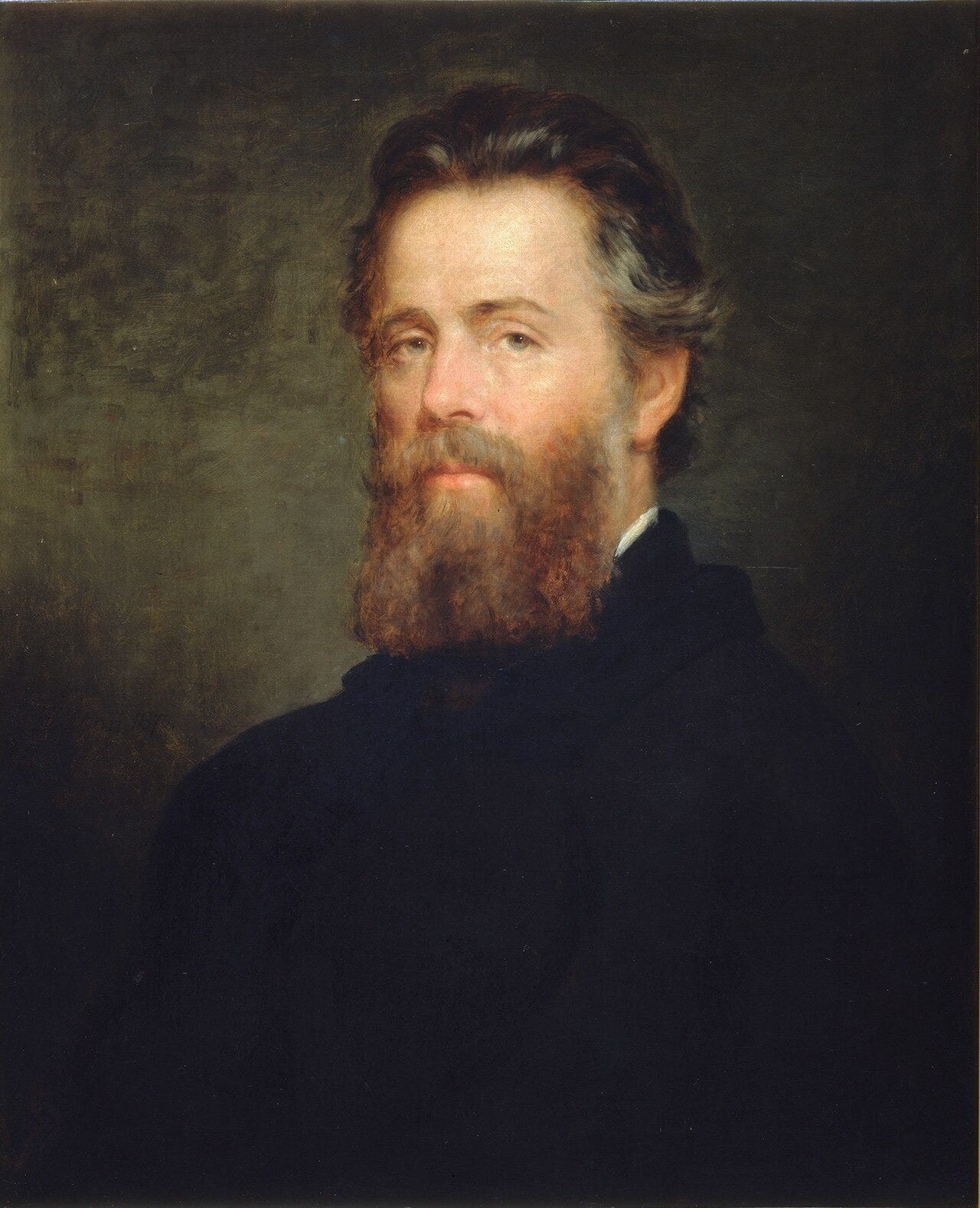
A few years later, he spent eighteen months aboard a whaling ship, Acushnet, sailing around South America and into the Pacific ocean. When the ship arrived at the Marquesas Islands, Melville decided to abandon the ship along with his shipmate — the two of them, as they wandered into the island, accidentally came across a tribe of cannibals,1 with whom he stayed until they were rescued four weeks later.
But on this new ship, he again suffered from poor conditions and became involved in a mutiny — he then spent a few weeks in a British prison. After he was freed, Melville spent time in Tahiti and Hawaii trying to earn money to make his way home.
Later in life, Melville developed a deep admiration and respect for Nathanial Hawthorne, another American writer.
Melville and Hawthorne first met in 1850 at a literary gathering in the Berkshires. A few days later, Melville published a glowing review of Hawthorne’s short story collection Mosses from an Old Manse. Though the men wrote many letters to each other over the course of years, only ten of Melville’s letters to Hawthorne survive, most of which read, at least from a modern perspective, remarkably like love letters.
Scholars have frequently cited Hawthorne’s influence on the novel. Leon Howard wrote that it was Hawthorne who moved Melville’s prose away from the “exhausted autobiographical pattern of personal experience” which he relied on in his earlier books.
Moby Dick’s Initial Reception: A Critical and Commercial Failure
When Moby Dick was first published in 1851, an early review in Literary World wrote that it “violated and defaced…the most sacred associations of life” — a reference to the homoerotic tones of Ishmael and Queequeg’s relationship (but Hawthorne, loyal as ever, disagreed; he praised Moby Dick as Melville’s best work).
The novel sold fewer than 4,000 copies in Melville’s lifetime, possibly because the novel occupied an uncertain place in the market: it was deemed a failure by critics, and was seen as too dark and philosophical for commercial audiences. By the time he died in 1891, Melville was all but forgotten.
In 1919, the centenary of Melville’s birth, scholars began to reinvestigate his work.
Raymond Weaver, an English instructor, set out to write a biography that would be published in 1921; simultaneously, Carl Van Doren, an English professor and literary editor published The American Novel, a set of essays on Hawthorne, Twain, James, and Melville.
“It was Melville’s abiding craving to achieve some total and undivined possession of the very heart of reality.”
— Raymond Weaver, Nation (August 2, 1919)
And suddenly, Moby Dick earned a spot as one of the greatest works of American literature.
And now, in 2026, we find ourselves wondering: does this book deserve to be called a classic? What does it have to say to us in the 21st century?
How to Approach Moby Dick
Since Moby Dick was written in English, and therefore there aren’t translation nuances to negotiate, you should read whichever version is easily available to you.
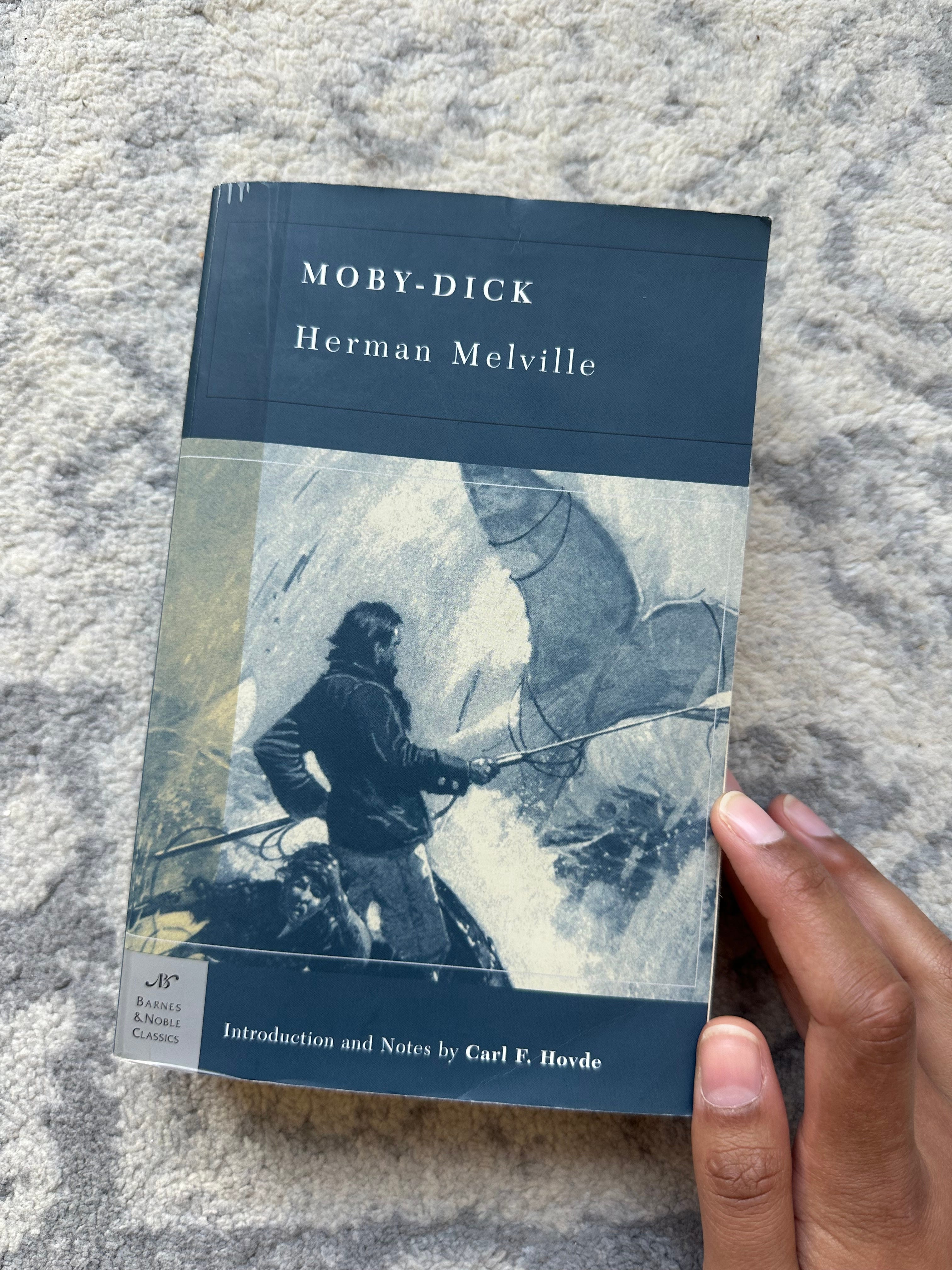
Neha and I both read the majority of this book in tandem: with the book in front of us as we listened to the audiobook. This was a wonderful reading experience, which we highly recommend!
Because the language is flowery and often goes on tangents, it is nice to have the words in front of you to feel more grounded. But the rhythm and cadence of the sentences can be challenging to get into, so having a professional read it aloud helps with understanding the flow.
The audiobook we recommend is narrated by Anthony Heald.
Maps, Whaling Terminology and Other Reference Sources
Most of this book is spent aboard the Pequod, a whaling ship that takes our characters all over the world.
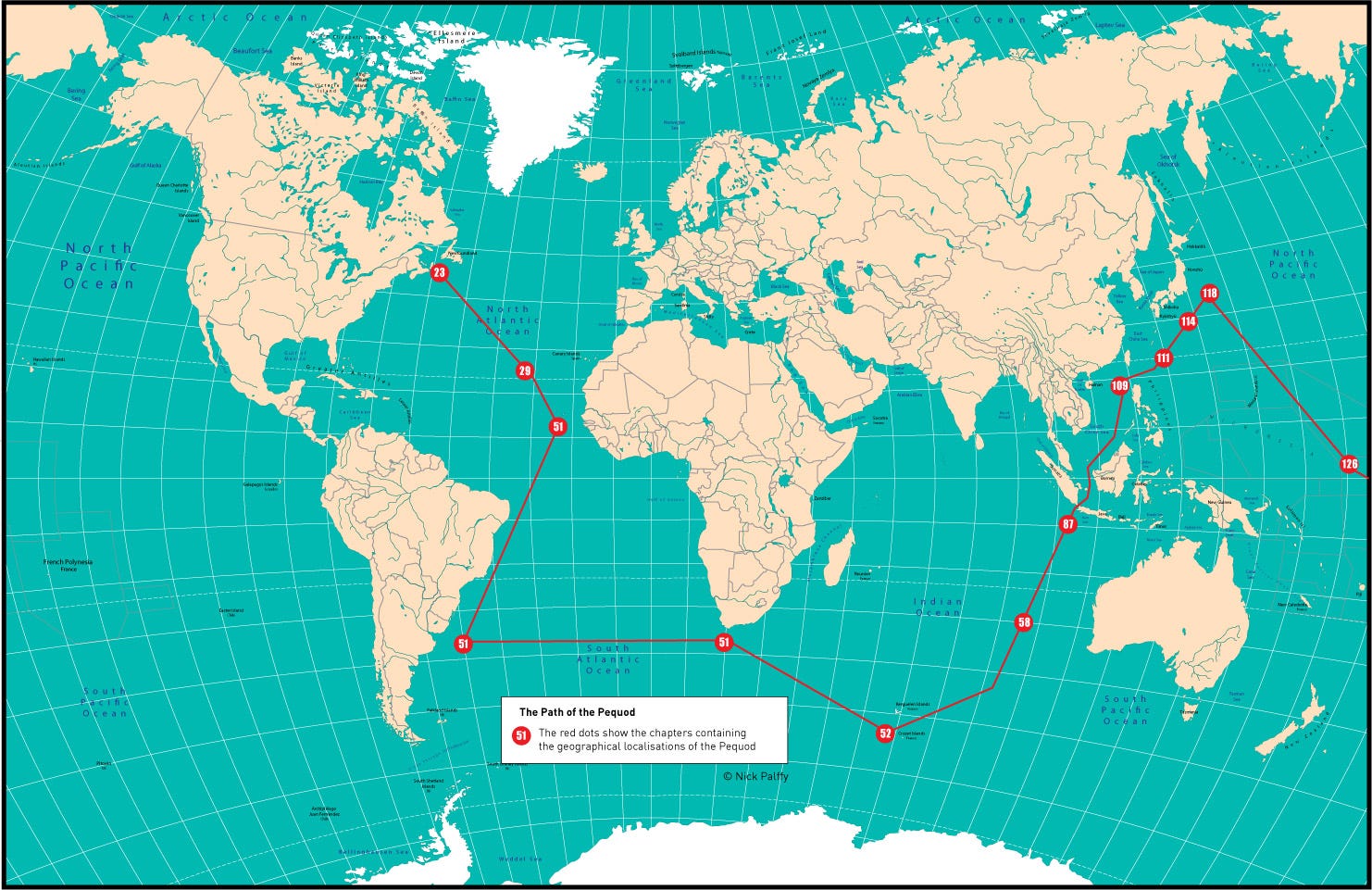

As we follow their journey, we learn an immense amount of information about whales, whaling, and seafaring. Here are some reference resources you might like to turn to as you read:
Cetology: A guide to Chapter 32 (Cetology), in which Melville exaggerates and conflates different types of whales in his attempt to map out the various species
Diagrams of 19th century whaling ships: these labelled illustrations might give you a sense of what the Pequod actually looked like
Online annotated Moby Dick: if your copy isn’t an academic or annotated version but you’d still like line-by-line notes, check out this online resource
Photos and historic artifacts: browse the online catalog of the New Bedford Whaling Museum to get a feel for the time in which the book was written
Character Guide
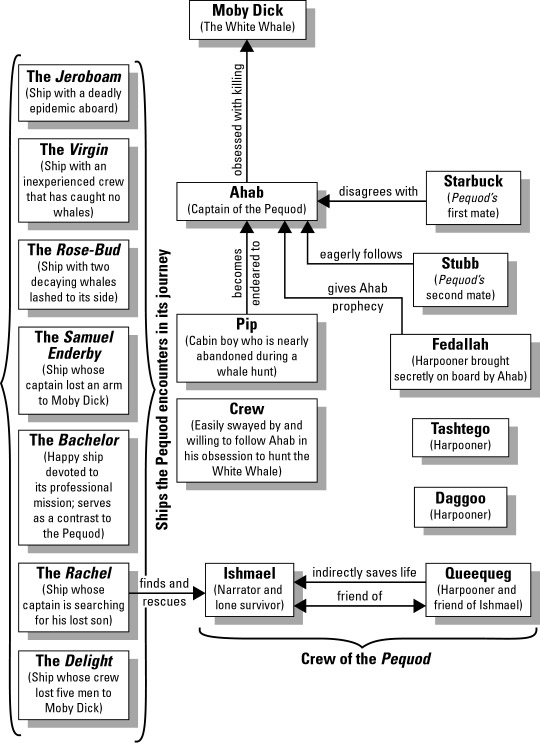
Ishmael: our narrator and a junior member of the crew aboard the Pequod
Queequeg: a prince from a South Sea island, and, according to Ishmael, a “cannibal.” Ishmael’s best friend and likely lover
Captain Ahab: captain of the Pequod
Moby Dick: the great sperm whale being chased by Ahab, also referred to as the White Whale
Starbuck, Stubb, and Flask: first, second, and third mate, respectively, of the Pequod. Each plays his own role in balancing the energy on board: sometimes rational, sometimes playful, sometimes in direct opposition to Ahab.
Fedallah, Tashtego, and Daggoo: a Middle Eastern man, a Native American, and a Black American man, respectively — or, as I like to call them, the ‘diversity quotient.’2
Pip: a young Black boy whose role is not unlike that of the jester in Shakespeare’s plays.
Peleg and Captain Bildad: owners of the Pequod and in charge of hiring the crew.
Here is a character map for a visual version (contains spoilers!).
Call Me Ishmael: That First Line
Moby Dick begins with one of the most famous lines in English literature: “Call me Ishmael.” In our episode, we talk about how baffling this line is, because Ishmael turns out to be a rather inconsequential character, barely appearing in most chapters.
Why, then, is this first line so famous?
For starters, it is the first of many Biblical allusions (as we’ll see below) important to this novel.
In Genesis, Ishmael is Abraham’s illegitimate son, fathered through his wife’s servant Hagar. Hagar, on learning of the pregnancy, runs into the woods and encounters an angel who tells her: “[thou] shalt call his name Ishmael; because the Lord hath heard thy affliction.”
“Call me Ishmael,” then, mirrors this language. Ishmael, in the Bible, is an outcast and a wanderer, much like the character in Moby Dick.
Maybe, the choice of these three words indicates to us that Ishmael is going to be an unreliable narrator — or at least one whom we should question. It asks us to interrogate our assumptions about the story, who its protagonist is, and our interpretation of its ending.
Or perhaps the line is famous for its simplicity. “Call me Ishmael” is an invitation — we might introduce ourselves as ‘My name is Ishmael’ but call me implies a closeness. It might be a nickname, or a secret appellation. We are being taken in to the narrator’s confidence.
It also sets the stage for Melville’s writing style throughout the rest of the book, which is surprisingly experimental (almost post-modern in some chapters), and often breaks the fourth wall.
Themes to Consider
Consumption

The idea of ‘consumption’ comes up in many ways in Moby Dick — from the literal consumption of human flesh (cannibalism) to the metaphorical consumption of one’s life, soul, and purpose. There is also consumption represented by the taking of meals, and the burning away of a candle made of spermaceti oil; not to mention the fear of being consumed — either by a monstrous creature of mythologic proportions, or by one’s own obsessive mania.
Free Will and the Individual vs the Collective
Ishmael’s intermittent presence as a narrator is interesting for another reason: one of the key themes in this book is the individual, in contrast to the collective. In Chapter 47, ‘The Mat-Maker,’ Ishmael and Queequeg work together to weave a mat, exploring as they go the idea of collectivism and free will. Throughout the novel, these ideas are explored alongside fate and destiny. Consider how these ideas might reflect or challenge American ideals of Capitalism, individualism, and democracy.
Man vs. Nature and Real vs. Supernatural
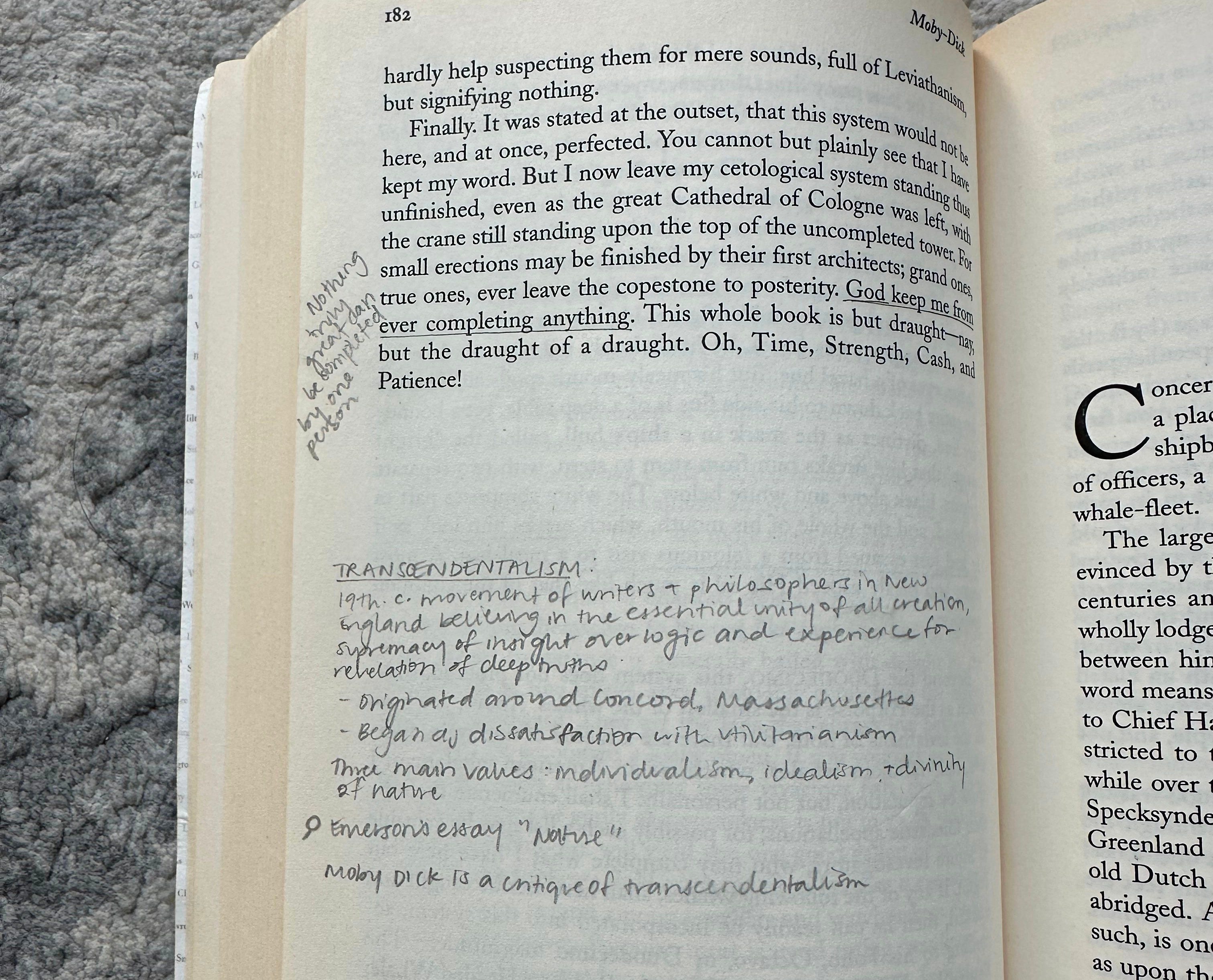
Anyone who has even a glancing understanding of the plot of Moby Dick will recognize that this is a core theme in the novel. But more so than just a simple allegory of man vs. beast, the story questions the ideas behind this theme by exploring the tenets of transcendentalism, Romanticism, and naturalism (more on this on the podcast episode).
Moby Dick came out eight years before the publication of Darwin’s On the Origin of Species — and Melville was writing alongside many of Darwin’s theories. Melville’s detailed descriptions of whale anatomy, physiology, and behavior work to counteract his own depictions of the whale as a supernatural creature beyond our understanding.
Religious, Literary, and Mythologic Allusions
Moby Dick is stuffed with allusions, parables, and references to all manner of cultural and historical stories. While an exhaustive list would be nearly impossible to complete, there are a few stories that repeatedly crop up throughout the novel, adding texture to its central themes.
Jonah and the Whale
The story follows the prophet Jonah, who is commanded by God to go to the city of Nineveh and warn its people of impending judgment. But Jonah, who hates the Ninevites and does not want them to have God’s mercy, runs away to a ship headed in the opposite direction.
While Jonah is sleeping below deck, God creates a supernatural storm that threatens the lives of everyone aboard. Accused by the other sailors, Jonah finally confesses that he is running from the Lord, and insists that they throw him aboard to save the crew. Rather than let Jonah drown, God sends a “great fish” (often depicted as a whale) to swallow him whole.
Jonah stays in the belly of the whale for three days and three nights, during which time he prays to God and repents for his disobedience. Finally, God commands the fish to vomit Jonah safely onto land.
The story emphasizes that repentance leads to forgiveness — but the story is also a threat. Behave badly, disobey God, and you shall be punished.
King Ahab
According to the Hebrew Bible, King Ahab was a ruler of Israel who became famous for his poor moral decisions and his worship of a false God. His idolatry in particular angered God, resulting in the prophet Elijah accusing him of foresaking God’s commandments (on the Pequod, a ‘prophet’ Elijah warns Ishmael against sailing with Captain Ahab).
In the Bible, King Ahab is involved in four prophecies (a fact that you might notice is mirrored in Moby Dick):
Elijah predicts a drought because of Ahab’s sins
An unnamed prophet states that Israel will be invaded by the Arameans as punishment for Ahab’s sparing a Ben-Hadad, rival king
Jezebel has an innocent man murdered so Ahab can seize his vineyard — the resulting prophecy is grim: dogs will lick Ahab’s blood and every male heir of his will but cut off and destroyed
Micaiah sees Israel scattered on the hills “like sheep without a shepherd,” spelling Ahab’s death
Ahab was also a real king — a document from the Neo-Assyrian Empire described the defeat of a dozen kings in the Battle of Qarqar, one of whom was Ahab.
The idea of King Ahab being both a real-life person and a mythical figure is very much in keeping with the themes of Moby Dick.
Leviathan
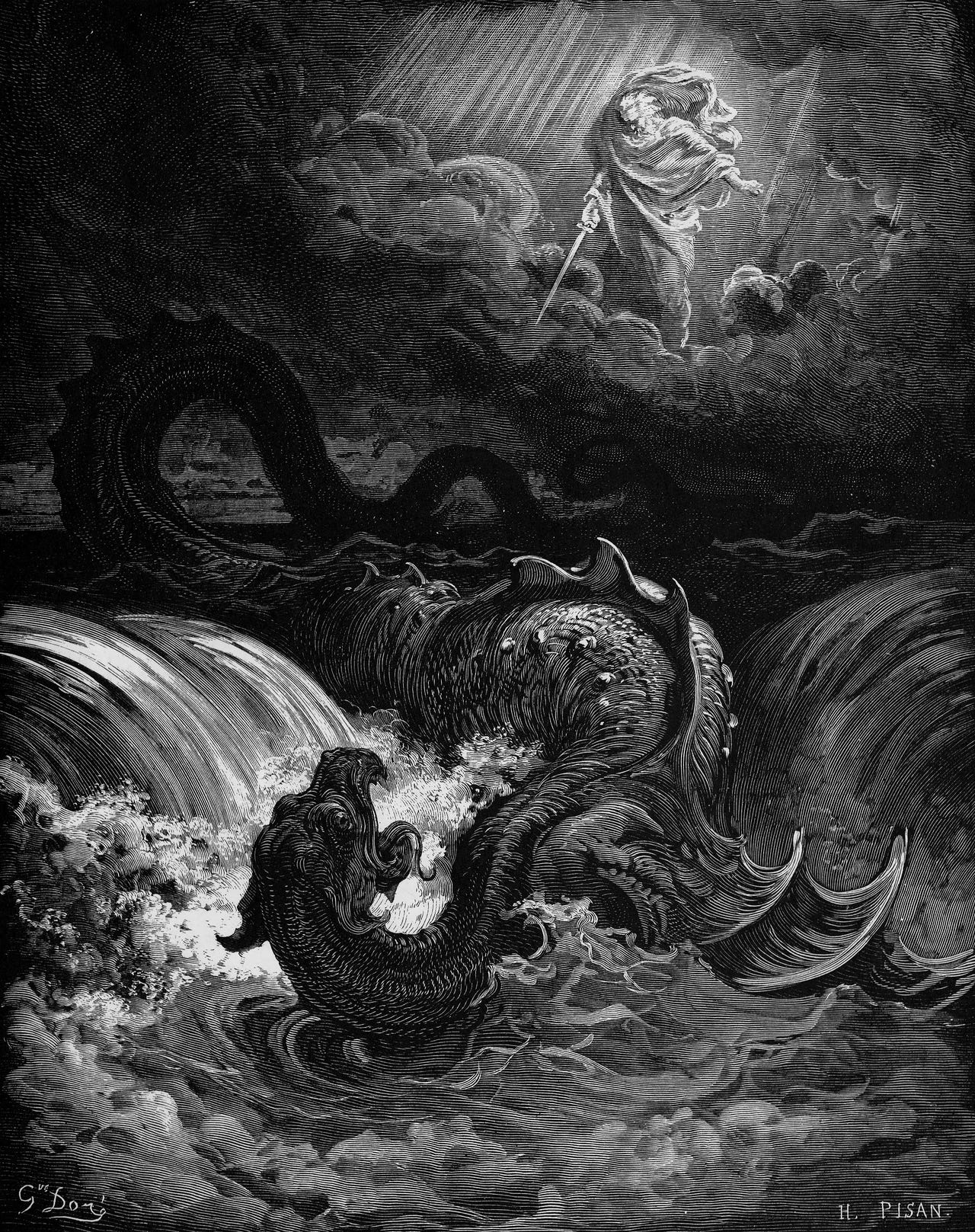
In the Old Testament, Leviathan is a fire-breathing sea monster that symbolizes chaos and evil. One of its most detailed descriptions comes from the Book of Job, in which God challenges Job to catch or tame the creature — though as he asks Job a series of questions about how he would go about catching it, he realizes the vast difference between human limitation and God’s power: if he can’t even tame this creature, how could he stand up against God?
Melville often describes the whale as Leviathan, frequently calling to mind an other worldly, all-powerful creature.
Shakespeare: King Lear, MacBeth
While reading Moby Dick, I constantly found myself thinking of Shakespeare. Both because of the rhythm and cadence of his language, and because of the larger-than-life themes, the way he is able to capture conflict and pathos in a way that few writers ever have.
“Melville meditated more creatively on Shakespeare’s meaning than any American has done.”
— F. O. Matthiessen, American literary critic
And, as we discuss on the podcast, the structure of Moby Dick feels a lot like a play — it often reads more like theater than a novel.
I was reminded, in particular, of Macbeth (prophecies and supernatural forces of evil), and King Lear (awe-inspiring forces of nature, divine fury).
What other Biblical mythology and Shakespeare allusions did you notice in Moby Dick?
Further Reading: Essays and Online Posts
What Moby Dick Means to Me by Philip Hoare in The New Yorker
“To my mind, there are only two other works with which it bears comparison: Mary Shelley’s “Frankenstein” (1818), and Emily Brontë’s “Wuthering Heights” (1847).” [I can’t help but agree!]
The Literal (and Figurative) Whiteness of Moby Dick by Gabrielle Bellot on Lithub
An investigation into the color white in the novel
Moby Dick is a Novel That is Mostly About Whales by Naomi Kanakia on Substack
Further Reading: Companion Texts and Scholarly Works
Call Me Ishmael: A Study of Melville by Charles Olson
The Function of the Cetological Chapters in Moby-Dick by J.A. Ward
Ahab’s Rolling Sea: A Natural History of Moby-Dick by Richard J. King
Lovers of Human Flesh: Homosexuality and Cannibalism in Melville’s Novels by Caleb Crain
So, Is Moby Dick the Great American Novel?
You’ll just have to read it and let us know what you think!
— Shruti
Reading Mrs. Dalloway: A Comprehensive Guide

When I first tried to read Mrs. Dalloway, many years ago as a teenager, most of it went over my head. I couldn’t follow the threads of story; I couldn’t grasp the interconnected themes.
A Reader's Guide to Agatha Christie

I have always loved reading mysteries — my love for this genre probably started with Nancy Drew and Harry Potter, but I really hit my stride when I discovered Agatha Christie and Arthur Conan Doyle.
Whether or not the tribe he met was actually composed of cannibals is a bit suspect. But regardless of the true customs of the local people, it’s clear that this encounter deeply impacted Melville, appearing in multiple future publications.
Jokes aside, this book is both surprisingly diverse and inclusive, and horrifically racist — more on that in our episode.
I am listening right now now to William Hootkins! Recommende highly! I will go back and read later! I’m in love!!
Saving this for the day I eventually read--too many people have told me it's worth it to ignore!